
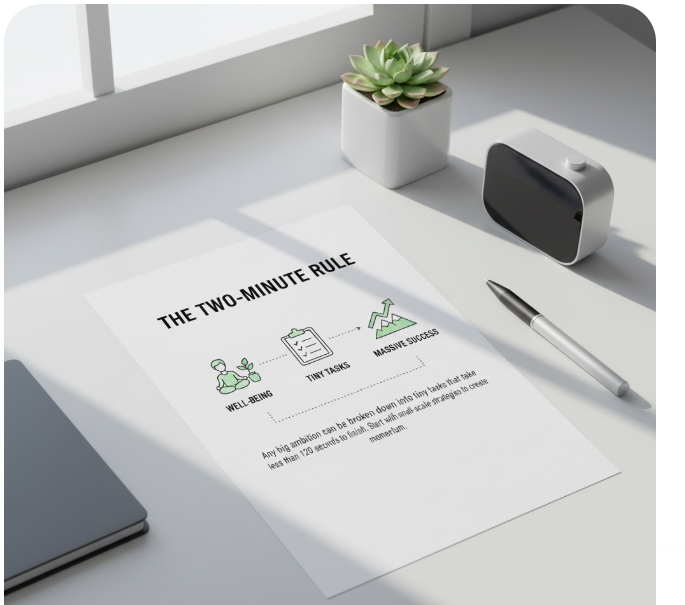
We have often observed that people fail at self-improvement because they treat it like a mountain that must be climbed in a single day. However, according to our research into human psychology, the most effective way to change your life is to use the Two-Minute Rule. This rule suggests that any big ambition can be broken down into tiny tasks that take less than 120 seconds to finish.
If you want to improve your well-being, don’t wait for a “perfect time.” We have seen that starting with these practical, small-scale strategies creates a momentum that eventually leads to massive success.
Psychology of the “Full Glass” (Availability Bias)
In our observation, many people are chronically dehydrated and don’t even realize it. Dehydration leads to headaches and fatigue, which kill your productivity.
We suggest keeping a very large glass of water on your desk at all times.
The “Why” it Works: We have noticed a psychological trick called Availability Bias. When your brain sees a large amount of water right in front of you, it thinks, “I should drink that.” By keeping the glass full, you trick your brain into hydrating more often without needing “willpower.”
2. The Whole Food Swap
We have seen that your energy levels are directly tied to the number of ingredients in your food.
As a general rule, the fewer ingredients on a label, the more nourishing the food is.
Take a look at your next meal. If you cannot pronounce the chemicals or dyes on the label, your body likely won’t know how to process them either. We recommend swapping processed meals for “Whole Foods” like eggs, nuts, fruits, and vegetables. We have noticed that this small change prevents the “afternoon slump” that makes most people feel sluggish.
3. Gratitude and the “Reticular Activating System” (RAS)
You might hear about gratitude often, but we have researched the neuroscience behind it. Your brain has a filter called the Reticular Activating System. When you practice daily gratitude, you are essentially “priming” your brain to look for opportunities and success instead of problems.
Keep a small journal next to your bed. Before you sleep, write down everything you were grateful for that day on a single page.
We have seen that people who do this are statistically more likely to reach their long-term goals because their minds stay clear and positive even during stress.
4. Use “Availability” to Read More
If you struggle to find time to read, we suggest using the same “Availability” trick we used for water.
Keep 3 or 4 physical books on your desk or near your couch.
When books are waiting for you, you are more likely to pick them up than to reach for your phone. Even if you only read for two minutes, you are downloading a lifetime of someone else’s wisdom.
5. Curating Your Digital Environment
If you prefer listening over reading, we suggest shifting your YouTube habit. Instead of scrolling through endless entertainment, we have found that searching for specific topics like “Personality Psychology” or watching a TED Talk provides a much-needed hit of inspiration.
Find colleges that upload their entire semester lectures online. It is like getting a free university education in two-minute bursts while you commute or relax.
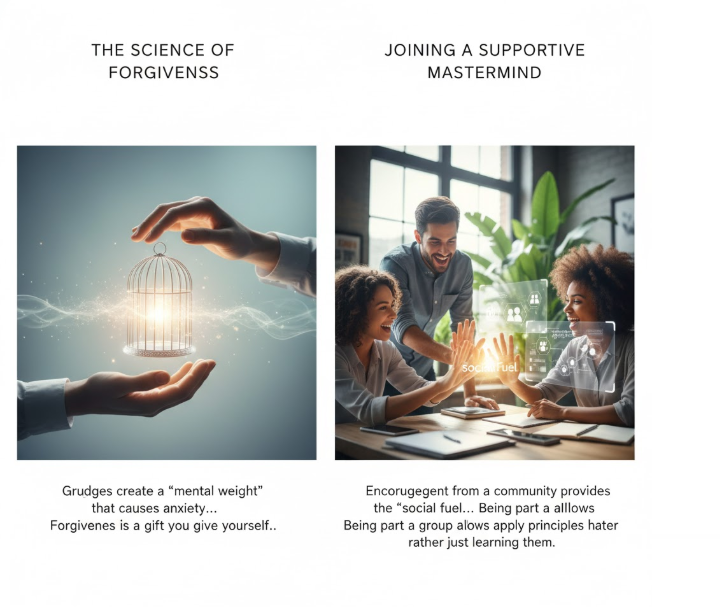
6. The Science of Forgiveness
We have researched the consequences of holding grudges, and the results are severe. Grudges create a “mental weight” that causes anxiety and limits your mindset.
Forgiveness is a gift you give yourself, not just the person who wronged you. When you let go of a grudge, you release the stress chemicals that have been clouding your judgment. We have seen that forgiving others—even if they didn’t ask for it—is a vital step for a successful mindset.
7. Joining a Supportive Mastermind
It is very difficult to accomplish big dreams alone. In our experience, encouragement from a community provides the “social fuel” needed to keep going.
- We recommend using platforms like Meetup or Facebook Groups to find people in your specific field, whether it’s real estate, writing, or tech.
- We have observed that being part of a group run by experts—like a private mastermind—allows you to apply principles rather than just learning them. This “Actionable” approach is what separates those who grow from those who stay stuck.
8. Self-Reward and Positive Reinforcement
Finally, we have noticed that the self-development community is often too hard on itself.
Congratulate yourself for every small step. If you drink your 8 glasses of water or read 2 pages, take a moment to reflect on that growth.
Positive reinforcement—even when it comes from within—encourages the brain to repeat the behavior tomorrow. Consistently contributing to your own improvement is how you change your world.






1 comment